On this page
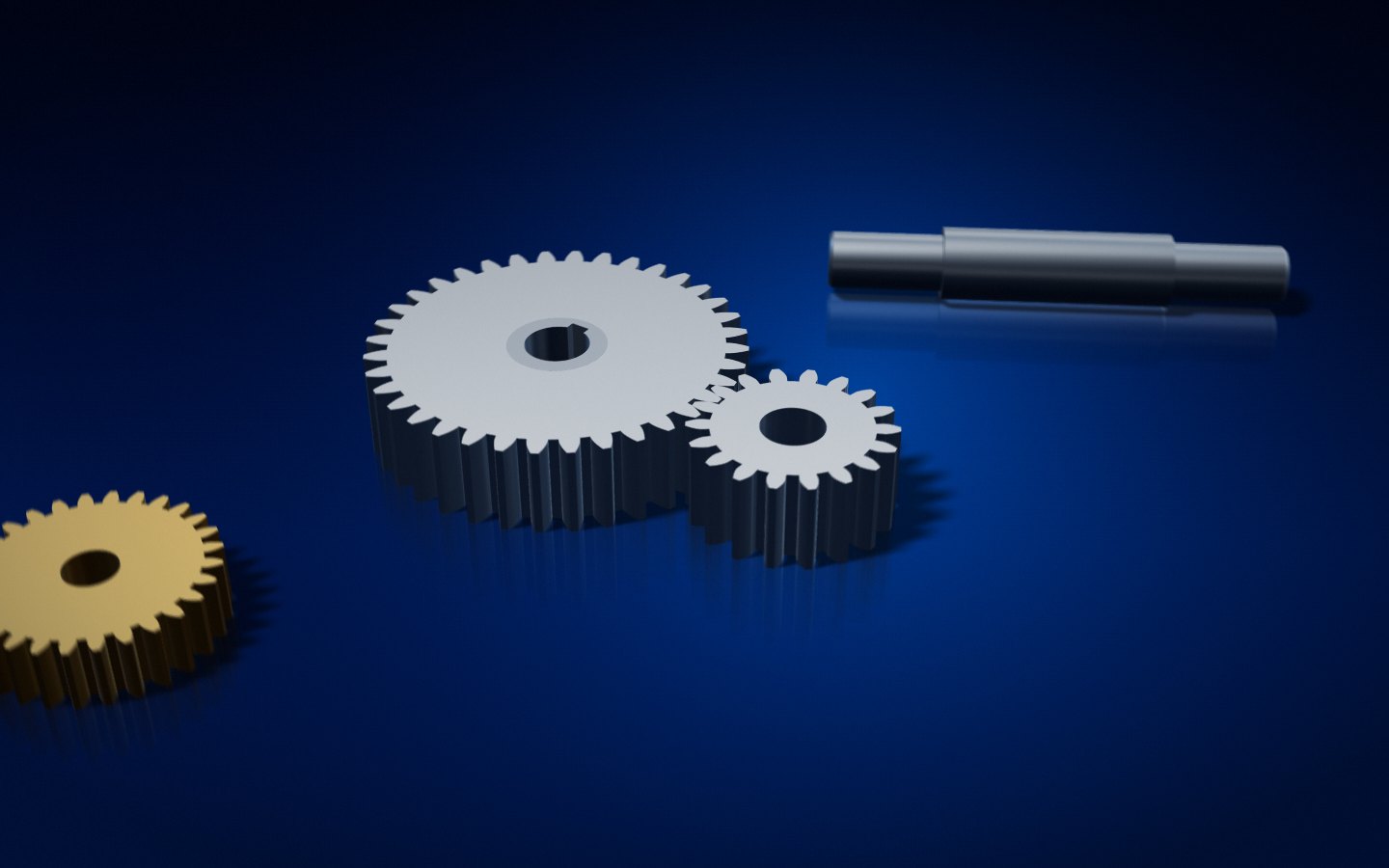
A spur gear is defined by a handful of numbers. Get them right and two gears mesh smoothly at the right centre distance; get one wrong and they will not mesh at all. Metric gears are sized by their module, which keeps the arithmetic simple.
Module and pitch diameter
The module m is the pitch diameter divided by the number of teeth z. So the pitch diameter, the circle on which two gears roll against each other, is:
d = m × z
An 18-tooth gear of module 2 has a pitch diameter of 36 mm. Two gears can only mesh if they have the same module and the same pressure angle. Inch gears use diametral pitch (DP), the number of teeth per inch of pitch diameter, instead. The two convert with m = 25.4 / DP, so DP 10 is close to module 2.5 but not equal to it, and the two systems are not interchangeable.
The other diameters
For a standard gear with a full-depth tooth:
Scroll the table sideways to see all columns on a small screen.
| Size | Formula | Module 2, 18 teeth |
|---|---|---|
| Pitch diameter | m z | 36.0 mm |
| Tip (outside) diameter | m (z + 2) | 40.0 mm |
| Root diameter | m (z − 2.5) | 31.0 mm |
| Whole depth of tooth | 2.25 m | 4.5 mm |
| Circular pitch | π m | 6.283 mm |
The tip diameter is the size the gear blank is turned to before the teeth are cut, so it is the first number a machinist needs.
Centre distance
Two standard gears mesh at half the sum of their pitch diameters:
a = m (z₁ + z₂) / 2
An 18-tooth pinion driving a 40-tooth gear at module 2 needs a centre distance of 2 × 58 / 2 = 58 mm, and gives a ratio of 40 / 18 = 2.22 : 1. Bore the housing to this distance with a tight tolerance: too close and the gears bind, too far and the backlash grows and the teeth lose contact.
Pressure angle
Almost all modern gears use a 20° pressure angle. 14.5° gears are still found on older machines, and 25° is used where stronger teeth matter more than quiet running. A 20° gear will not mesh properly with a 14.5° gear, even at the same module.
Small pinions and undercut
When a 20° gear with fewer than 17 teeth is cut with a standard hob, the cutter takes material from the root of each tooth. This undercut weakens the tooth and shortens the contact. The usual cure is a positive profile shift, which moves the cutter outwards so the teeth are thicker at the root. For a 12-tooth pinion, a shift of about 0.3 is enough. Profile shift also changes the centre distance, which is a useful way to fit new gears into an existing housing.
Contact ratio
The contact ratio is the average number of tooth pairs in mesh at any moment. It must be above 1 for the gears to work at all, and 1.2 or more for smooth, quiet running. The 18 and 40 tooth pair above has a contact ratio of 1.62.
Checking a finished gear
Tooth thickness is hard to measure directly, so gears are usually checked with a span measurement: the distance across a set number of teeth, taken with disc micrometers. For module 2, 24 teeth and 20°, the span over 3 teeth is 15.433 mm, less the backlash allowance given on the drawing.
What to give when you order a gear
- Module or DP, number of teeth and pressure angle
- Profile shift, if any, or the centre distance the gear must run at
- Face width, bore, keyway and hub details
- Material and heat treatment, such as through-hardened 42CrMo4 or case-hardened 16MnCr5
- Accuracy grade, for example to ISO 1328, and the mating gear if it is a replacement
For a worn gear with no drawing, count the teeth and measure the tip diameter: for a standard gear, the tip diameter divided by the number of teeth plus two gives the module. Two span measurements over different numbers of teeth give the base pitch, which confirms the module and pressure angle and shows whether the gear was profile shifted.